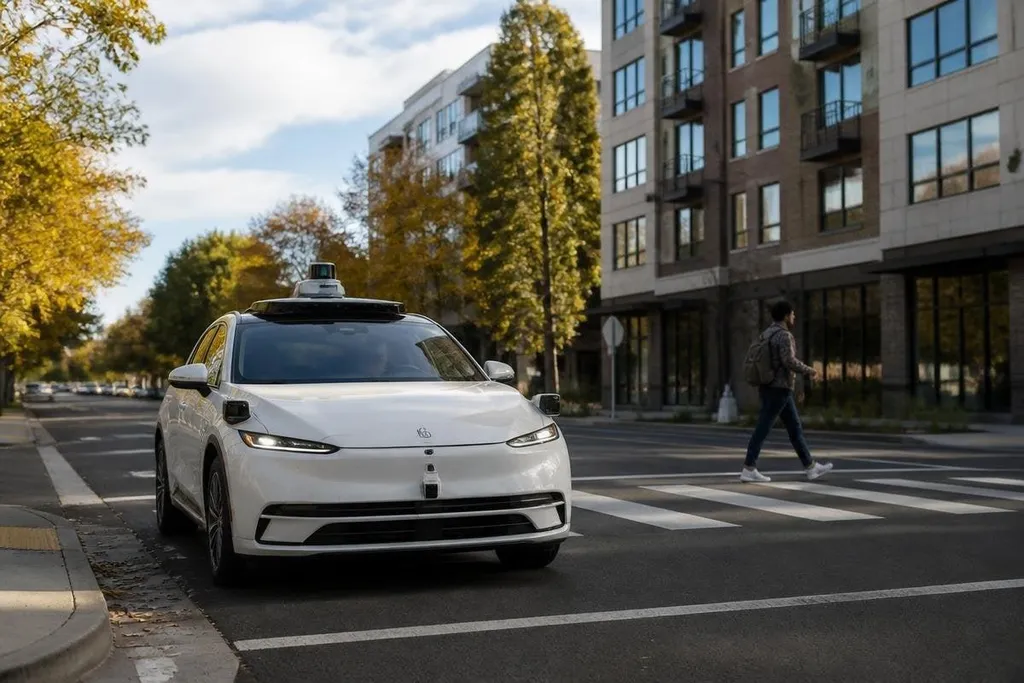
A robotaxi has to read roads, predict people, choose a safe path, and explain its actions when something goes wrong. AI now handles much of that work, but the hard question has moved from “can it drive?” to “can anyone prove that it drives safely?”
- AI combines camera, radar, and LiDAR data into one view of the road.
- Prediction software estimates what nearby people, cars, and cyclists may do next.
- Remote teams still matter when the vehicle meets a case its software cannot settle.
How AI reads the road
A robotaxi starts with sensors. Cameras record color and road signs, radar measures distance and speed, and LiDAR sends out laser pulses to map nearby objects. Each sensor sees a different part of the scene, so the software combines their data before the vehicle chooses an action.
That combined view is called sensor fusion. The vehicle can tell a parked car from a moving one, track a cyclist across several frames, and keep a map of lanes, curbs, and traffic lights. The result feeds the driving system several times each second.
AI can also flag objects that do not fit a clean label. A road worker may stand beside a temporary barrier, or a delivery van may block a lane. Image and motion models can mark the scene as unusual, then give the planning system more time to slow down or stop.
The limit is clear. A model can spot a strange scene without knowing what the scene means. That gap is why robotaxi companies need road tests, simulation, safety review, and records from real trips.
Prediction matters as much as control
Seeing a cyclist is only the first step. The vehicle must estimate whether that cyclist will stay in the bike lane, cross the road, or move around a parked car. Prediction models use recent motion, road layout, traffic rules, and nearby objects to estimate several possible paths.
The planner then selects a path with enough space and time for the people around it. A cautious choice may delay a trip, while a tight choice may create a safety risk. That tradeoff appears at every turn, merge, pickup stop, and unprotected crossing.
AI changes the system again after each trip.
Engineers can review a recorded event, find where the software made the wrong call, add a matching case to a test set, and check whether a new model handles it better. The work is less like installing one finished feature and more like maintaining a driving system through repeated software updates.
A robotaxi claim needs a record of the route, weather, safety driver, and software version. Coverage from Robot 24 can set those details beside the reported result. The next test is harder: what did the vehicle handle, and when did a person still need to intervene?
The hard part is proving safety
A short video can show a vehicle stopping for a pedestrian. It cannot show how the same system behaves across every road type, weather condition, sensor fault, or confusing hand signal. That is why a serious review asks what the vehicle saw, what it predicted, what action it chose, and whether a human had to step in.
Simulation gives engineers a way to run rare cases many times. It can test a child running into the road, a blocked sensor, or a traffic light hidden by a truck. Simulation helps, but its value depends on how well its virtual roads match the roads where the robotaxi operates.
Remote assistance adds another layer. A remote operator may help the vehicle understand an unusual situation, but they cannot react like a passenger in the car. Network delay, poor camera views, and unclear responsibility can turn a small software problem into a larger one.
I’d judge a robotaxi by its unanswered cases, not its smoothest rides. A company that reports when the system stops, asks for help, or hands control back gives you more useful information than a polished launch video.
A buyer’s checklist for robotaxi claims
Use this list when you read a company release or assess a pilot:
- Name the service area: Check which roads, weather conditions, and operating hours the vehicle supports.
- Ask for intervention data: Find out how often remote staff had to guide or approve a trip.
- Check sensor limits: Look for details about blocked cameras, dirty LiDAR covers, glare, rain, and darkness.
- Separate test from service: A closed-course demo does not prove the same behavior on public roads.
- Find the safety record: Look for crash reports, stopped-trip data, and clear dates for the figures.
The next useful proof will come from repeated service data: where the robotaxi stops, how often people take over, and which cases remain unsolved. Until companies publish that record in a form others can check, AI has made robotaxis more capable, but it has not finished the safety argument.